
Uniswap Makes a Splash with $1.65 Billion Ecosystem Incentive - Can It Revitalize the DeFi Market?

Original Title: "Uniswap Community Allocates $165.5 Million to Incentivize Ecosystem Development, Where Is the DeFi Giant Heading Strategically?"
Original Author: Luke, Mars Finance
On March 20, 2025, the Uniswap community passed two governance proposals through on-chain voting, allocating a total of $165.5 million worth of UNI tokens to the Uniswap Foundation (UF) to incentivize ecosystem development. This funding will be divided into two parts: $95.4 million for developer grants and a two-year operational budget, and $25.1 million to support liquidity incentives for Uniswap v4 and Unichain. This decision not only marks Uniswap's largest community grant ever, but also reveals its ambition to pursue transformation and breakthroughs in the fiercely competitive decentralized finance (DeFi) market. This article will delve into the background of the proposal, strategic objectives, potential impacts, and challenges ahead, looking forward to the future development of the Uniswap ecosystem.
Background: Opportunities and Challenges Facing Uniswap
As a pioneer in the DeFi space, Uniswap's automated market maker (AMM) model has changed the landscape of digital asset trading since its launch in 2018. However, with the release of Uniswap v4 and the Layer 2 network Unichain in 2025, the project did not achieve the anticipated success promptly. Data shows that Uniswap v4's total value locked (TVL) is only $85 million, and Unichain is even lower, at only $8.2 million. Meanwhile, competitors are pouring up to $50 million worth of native token incentives monthly to grab market share. In this context, Uniswap urgently needs to revitalize ecosystem vitality through large-scale investment.
Furthermore, the community's call for a "fee switch" has never ceased. This mechanism aims to allocate a portion of protocol revenue from liquidity providers (LPs) to UNI token holders to enhance the token's value capture capability. However, due to the complexity of technology and governance, this feature has been slow to materialize, becoming the focus of community controversy. This allocation is seen as a key step towards paving the way for the "fee switch."
Core of the Proposal: Four Key Strategic Priorities
Uniswap Foundation has clearly outlined four major strategic directions for the next two years in the proposal, and the $165.5 million funding will revolve around these objectives:
1. Network Expansion: Enhancing Capital Efficiency
The goal is to provide the highest capital efficiency across all active EVM-compatible chains. To achieve this, Uniswap will leverage the innovative AMM features of v4 and Unichain's infrastructure to attract liquidity. A $45 million liquidity incentive program will be executed in collaboration with Gauntlet to boost TVL and market share in the short term. However, the foundation emphasizes that the long-term goal is not reliant on continued subsidies but rather on sustaining liquidity through organic demand.
2. Network Demand: Building a Premier Developer Platform
Uniswap v4 has lowered the barrier for developers to build new market structures through hooks, while Unichain has designed a Layer 2 environment optimized for DeFi. A $95.4 million grant budget will support the developer ecosystem, including educational programs (such as the Infinite Hackathon), infrastructure development, and the global developer ambassador program. Currently, over 1,000 developers are engaged in v4 hook development, creating more than 150 prototypes. The key to success lies in increasing the share of hook transactions and the number of Unichain developers.
3. Revenue Activation: Unlocking Value for Governance
Unichain has committed to allocating 65% of its on-chain net revenue to validators and stakers, while the foundation is exploring the establishment of a legal entity (such as DUNA) to enable governance entities to sign agreements with external entities and potentially introduce protocol revenue sharing. This sets the stage for the implementation of a "fee switch." If successful, UNI token holders will directly benefit, and the tokenomics will undergo a significant transformation.
4. Enlisting Core Contributors: Ensuring Long-Term Innovation
To achieve long-term sustainability, the foundation plans to introduce a "Core Contributors" program to fund development teams advancing Uniswap infrastructure (such as non-EVM versions or new hook protocols). These teams will collaborate directly with governance entities and receive compensation in UNI tokens. This initiative aims to reduce reliance on a single entity (such as Uniswap Labs) and promote governance decentralization.
Funding Allocation and Transparency Commitment
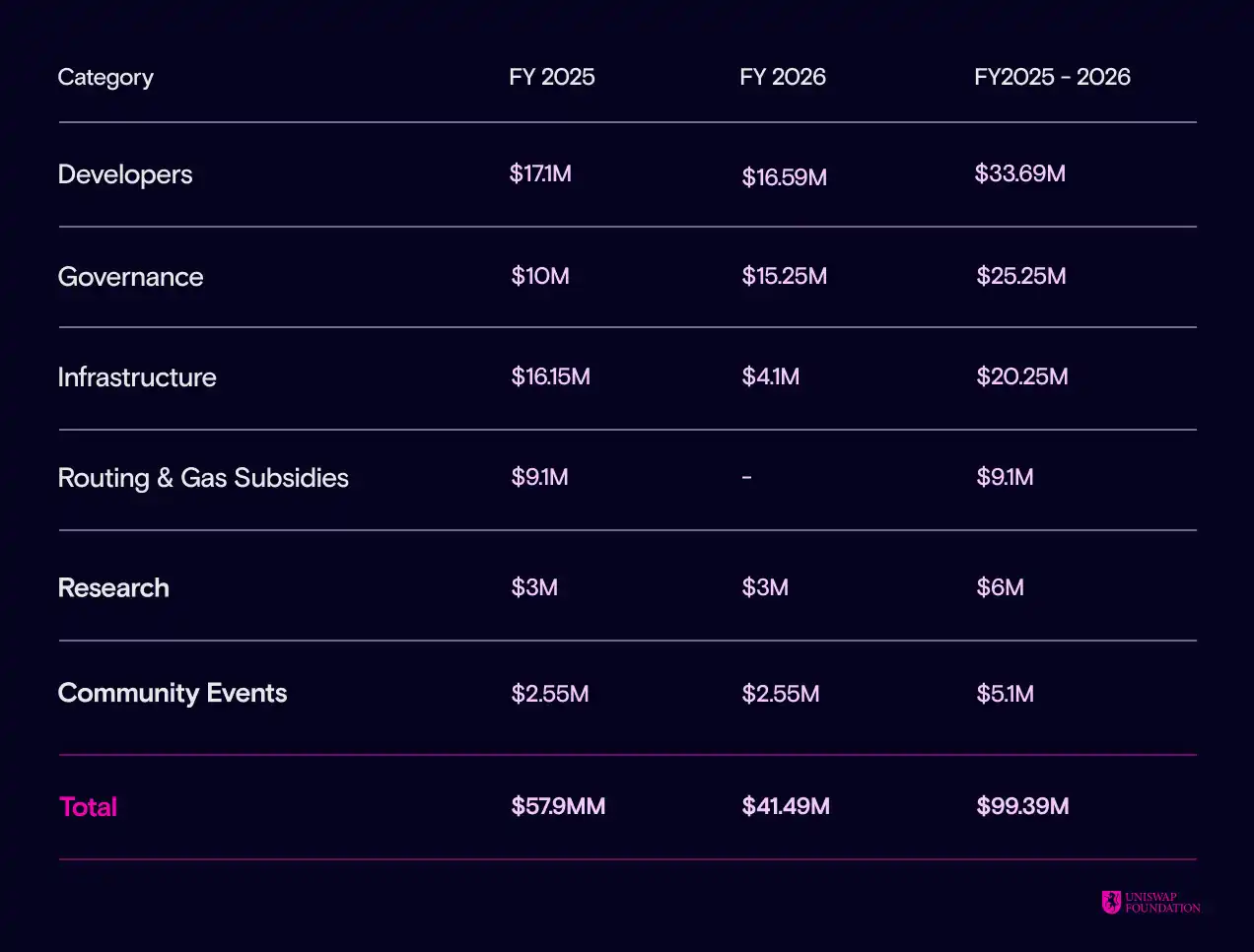
The proposal outlines the detailed use of funds:
· Grant Budget: $57.9 million for 2025 and $41.5 million for 2026, totaling $99.4 million (net $95.4 million). The funds will support developer projects and the Unichain ecosystem, with clear performance targets set (e.g., TVL, market share, etc.).
· Operating Budget: The two-year cash budget is $24.8 million, with an additional 1.5 million UNI (approximately $13.8 million) allocated for employee salaries. The foundation plans to onboard 12 new employees, covering governance, developer support, and other areas.
· Transparency Measures: The foundation commits to enhancing transparency through regular reporting and community meetings. By May 8, 2025, the foundation will collaborate with the Uniswap Accountability Committee (UAC) to establish a board of representatives to oversee strategic execution.
Potential Impact: Balancing Opportunities and Risks
Opportunities
Ecosystem Growth: The $165.5 million allocation, if executed properly, could significantly enhance the competitiveness of Uniswap v4 and Unichain, especially in the developer ecosystem and liquidity provision. Token Value Appreciation: The potential implementation of the "fee switch" would give UNI actual revenue attributes, attracting more investors. Governance Upgrade: The introduction of core contributors and legal entities will drive Uniswap towards a more decentralized governance model.
Risks
Funding Size Debate: Some community members question the necessity of the $165.5 million, pointing out that Uniswap Labs earned $171 million in front-end fees over two years but did not share the profits with UNI holders. This centralized model may erode trust. Liquidity Migration: The $45 million in incentives could potentially draw funds away from Ethereum or other Layer 2 solutions, creating opportunities for competitors. Governance Efficiency: There is still uncertainty surrounding the plans of core contributors and the implementation of a conditional liquidity market, and the governance structure's ability to manage effectively remains to be seen.
Market Response and Future Outlook
Following the proposal's approval, the UNI token price rose to $7.52 on March 19, with a daily increase of 5.62%, demonstrating the market's optimism about its growth plans. However, whether the price can continue to rise depends on the effectiveness of execution. In the short term, liquidity incentives and developer support may yield visible results; in the long term, the implementation of the "fee switch" and governance upgrades will determine whether Uniswap can solidify its DeFi leadership position.
The Uniswap community stands at a crossroads. This $165.5 million investment is not only a ramp-up of its technology and ecosystem but also a profound attempt to reform its governance model. For investors and observers, the upcoming execution details, market feedback, and community consensus will be crucial in determining Uniswap's future trajectory. Whether the pioneer of DeFi can continue to lead the trend, 2025 will be a decisive year.
You may also like

BIS's latest research: The future of stablecoins and the global monetary landscape
Morning News | Michael Saylor releases Bitcoin Tracker information; Aave releases post-attack investigation on Kelp rsETH bridge; Gravity Bridge announces service suspension after being attacked
Three years later: Looking back at my judgment of ChatGPT in 2023

From Casino Tools to Global Pricing Machines: The NYSE Leader's Perspective on Hyperliquid

A Detailed Analysis of "Stock God Serenity" Investment Methodology

Sharplink CEO: The future of Ethereum is unfolding
Morning Report | Korea Investment & Securities and OKX plan to jointly acquire 40% of Coinone; Polymarket denies implementing KYC comprehensively; Grayscale delays U.S. stock IPO plans
Bit Digital CEO: Why I Bought More ETH

A Decade of Three Waves of Stock Tokenization from Bitget's Reality: An Unfinished Financial Exploration

"Hu Run Baifu" Dialogue with Sun Yuchen: A New Paradigm of Value Circulation in the Web3 Transformation Cycle

Is it hackers and regulation that ruined DeFi?

Chris Lee: From crypto OG to heavy investments in the three storage giants, predictions on AI bull market corrections, Web4, and opportunities for the younger generation

Ready for a Walk on the Wilder Side of Proof of Talk 2026? Join WEEX Labs in Paris

Gold vs Bitcoin in 2026: Which Market Is Giving Traders Better Opportunities?

Morning News | Coinbase partners with Standard Chartered Bank to expand multi-currency fiat channels; Sharplink and Forward will be included in the Russell Index; JPMorgan may issue stablecoins in the future

Hash Global Founder: Why I Also Chose to Liquidate All My ETH?

Tokenized US Stock Duel: Ondo vs. xStocks, Who is Defining On-Chain Nasdaq?

He Yideng ranked: Since you're here, you might as well
BIS's latest research: The future of stablecoins and the global monetary landscape
Morning News | Michael Saylor releases Bitcoin Tracker information; Aave releases post-attack investigation on Kelp rsETH bridge; Gravity Bridge announces service suspension after being attacked
Three years later: Looking back at my judgment of ChatGPT in 2023
From Casino Tools to Global Pricing Machines: The NYSE Leader's Perspective on Hyperliquid
A Detailed Analysis of "Stock God Serenity" Investment Methodology
Sharplink CEO: The future of Ethereum is unfolding


