
Dissecting Saylor's Bitcoin Financial Magic: Stock Price Triples Since Last October

Original Article Title: Update on Strategy and Saylor
Original Author: JAY
Original Translation: Deep Tide TechFlow
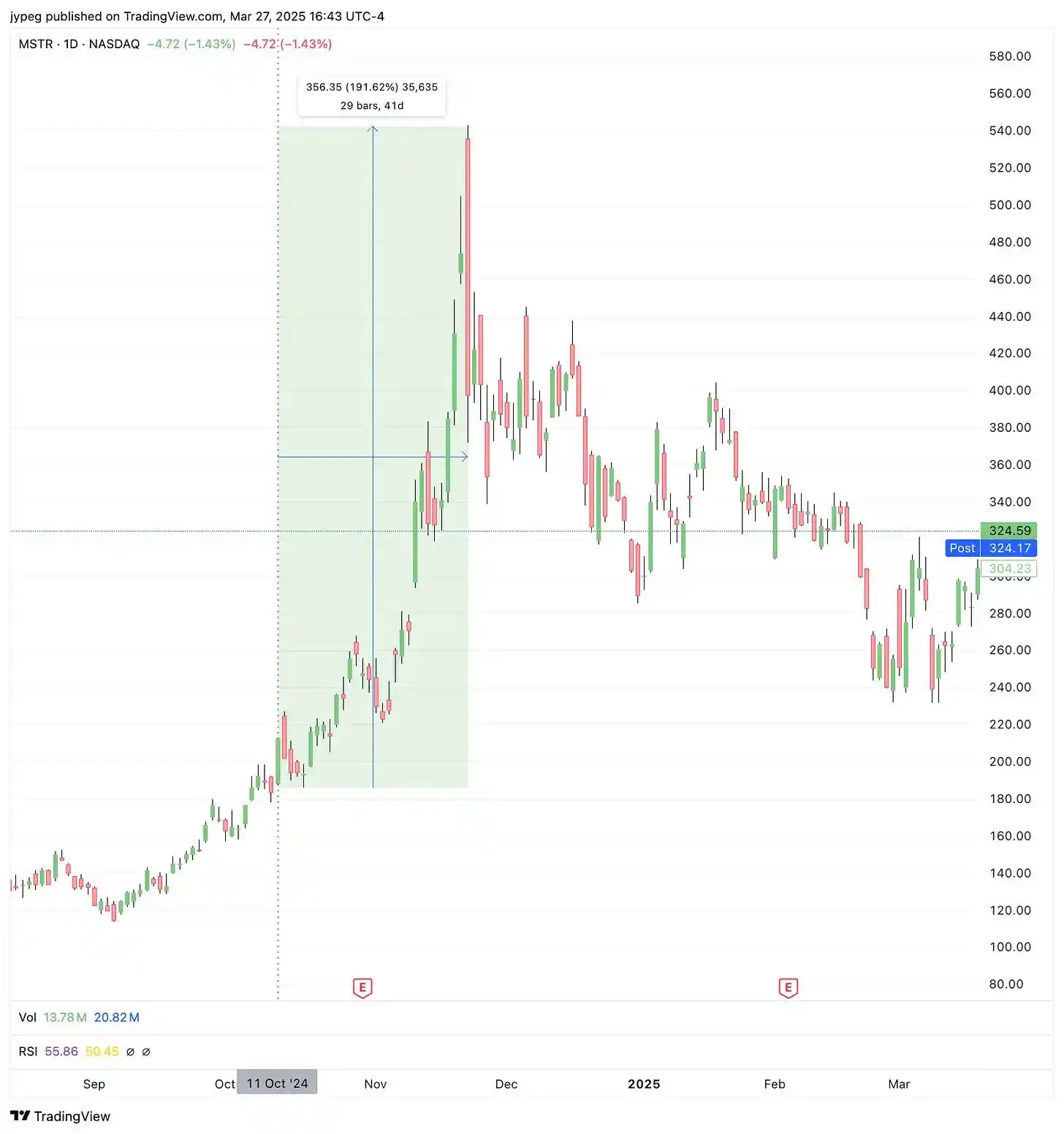
Since October 2024, the price of Strategy (MSTR) has experienced dramatic fluctuations. Soaring from $188 to $540, nearly tripling in value, but then falling back and stabilizing in the $300 low range.
Behind this price movement are a series of significant initiatives driven by company founder Michael Saylor, including changing the company name to Strategy, purchasing over 506,000 bitcoins (BTC), and issuing two new preferred stocks STRK and STRF.
However, there are many inaccurate interpretations in the market regarding how Strategy operates. To help investors more clearly assess whether Saylor's Bitcoin reserve strategy is sustainable, we attempt to simplify its core logic.
Saylor's Bitcoin Reserve Strategy: Two Key Points
Saylor's financial strategy can be summarized in the following two points:
1. Sell Stock Options to Realize Gains Upfront
Strategy sets the exercise price for MSTR stock purchase or conversion options at a range of 30% to 300% of the current stock price and collects all gains upfront through structured transactions. This is mainly achieved through issuing convertible bonds and preferred stocks STRK and STRF.
2. Dilute Stock at Opportune Times
Utilizing the At-the-Market (ATM) mechanism, to issue MSTR stock at market prices when market conditions are favorable to further raise funds.
It is important to note that Saylor does not have a clear plan to repay the principal of these options or bonds. His core goal is to maintain the long-term operation of the financing plan, paying interest until the MSTR stock price rises to the relevant exercise price.
The core advantage of this strategy lies in its highly flexible financing approach. Using this strategy, Saylor can choose the best fundraising tools based on market conditions:
· When implied volatility is high, issue convertible bonds;
· When MSTR stock's Net Asset Value (NAV) premium is high, issue more shares through the ATM mechanism;
If the above conditions are not met, issue more preferred stock (such as STRK or STRF).
Externally, there may be concerns about the high leverage risk of this strategy, but data shows that these concerns are unfounded. Here are key financial data points for MSTR:
· Market Cap: $850 billion;
· Bitcoin Holdings Market Value: Approximately $44 billion (506,000 BTC);
· Total Debt: $8.2 billion, with an annual interest rate of only 0.421%, resulting in annual interest expense of around $34 million;
· Preferred Stock Dividend Payments: STRK pays $58.4 million annually, while STRF pays $85 million annually.
An analysis of these data through ratio analysis reveals that Saylor's use of leverage is actually very limited, and the cost of debt is extremely low.
Bitcoin Reserve Strategy vs. Traditional Banking Model
Strategy's Bitcoin reserve strategy can be somewhat compared to the operational model of traditional banks. The core operating logic of both is as follows:
Traditional Banking Model
Banks amplify leverage through fractional reserve systems to increase returns, but this model occasionally leads to bank bankruptcies.
Receive customer deposits; use deposit funds to purchase "safe" government-backed debt (such as treasury securities, mortgage-backed securities, etc.); pay depositors interest lower than the return on debt investments.
Bitcoin Reserve Strategy
Unlike traditional banks, Strategy's Bitcoin reserve strategy does not use excessive leverage because, in case of trouble, the government will not provide a bailout similar to the banking industry.
Raise funds (similar to banks receiving deposits); purchase Bitcoin with the raised funds (rather than government-backed debt); pay investors MSTR stock returns and periodic interest or dividends.
Although the operating methods differ, the core goal of both models is to achieve profitability through fund management. Banks rely on net interest margin (the difference between debt investment returns and deposit interest) to benefit depositors with a portion of the debt interest passed on through the bank. Bitcoin reserve companies rely on Bitcoin's capital appreciation to benefit investors through the volatility of Bitcoin's price (refer to more detailed information to understand how this trading works and why this model is advantageous to convertible bond buyers). This appreciation mainly comes from the rise in Bitcoin prices or the depreciation of the US dollar against Bitcoin.
The Future Potential of Bitcoin Reserve Strategy
Michael Saylor is one of the most steadfast advocates of the Bitcoin reserve strategy. His asset management model has successfully attracted many companies to follow suit, prompting the U.S. government to begin exploring similar reserve strategies. The continuous rise of MSTR and Bitcoin prices has served as the best "advertisement" for this strategy, further driving market recognition of the Bitcoin reserve concept.
Although those who truly understand and accept Saylor's strategy are still in the minority, as Bitcoin and MSTR develop, the market impact and sustainability of this strategy are growing. Market attention and feedback, in turn, have driven the success of the strategy, and this "reflexivity" may bring longer-term development potential to the Bitcoin reserve strategy.
You may also like

BIS's latest research: The future of stablecoins and the global monetary landscape
Morning News | Michael Saylor releases Bitcoin Tracker information; Aave releases post-attack investigation on Kelp rsETH bridge; Gravity Bridge announces service suspension after being attacked
Three years later: Looking back at my judgment of ChatGPT in 2023

From Casino Tools to Global Pricing Machines: The NYSE Leader's Perspective on Hyperliquid

A Detailed Analysis of "Stock God Serenity" Investment Methodology

Sharplink CEO: The future of Ethereum is unfolding
Morning Report | Korea Investment & Securities and OKX plan to jointly acquire 40% of Coinone; Polymarket denies implementing KYC comprehensively; Grayscale delays U.S. stock IPO plans
Bit Digital CEO: Why I Bought More ETH

A Decade of Three Waves of Stock Tokenization from Bitget's Reality: An Unfinished Financial Exploration

"Hu Run Baifu" Dialogue with Sun Yuchen: A New Paradigm of Value Circulation in the Web3 Transformation Cycle

Is it hackers and regulation that ruined DeFi?

Chris Lee: From crypto OG to heavy investments in the three storage giants, predictions on AI bull market corrections, Web4, and opportunities for the younger generation

Ready for a Walk on the Wilder Side of Proof of Talk 2026? Join WEEX Labs in Paris

Gold vs Bitcoin in 2026: Which Market Is Giving Traders Better Opportunities?

Morning News | Coinbase partners with Standard Chartered Bank to expand multi-currency fiat channels; Sharplink and Forward will be included in the Russell Index; JPMorgan may issue stablecoins in the future

Hash Global Founder: Why I Also Chose to Liquidate All My ETH?

Tokenized US Stock Duel: Ondo vs. xStocks, Who is Defining On-Chain Nasdaq?

He Yideng ranked: Since you're here, you might as well
BIS's latest research: The future of stablecoins and the global monetary landscape
Morning News | Michael Saylor releases Bitcoin Tracker information; Aave releases post-attack investigation on Kelp rsETH bridge; Gravity Bridge announces service suspension after being attacked
Three years later: Looking back at my judgment of ChatGPT in 2023
From Casino Tools to Global Pricing Machines: The NYSE Leader's Perspective on Hyperliquid
A Detailed Analysis of "Stock God Serenity" Investment Methodology
Sharplink CEO: The future of Ethereum is unfolding


