
Bloomberg: Stablecoin Payments Emerge as Crypto VC's Newest Favorite Thing





Original Title: Crypto VCs Are Abandoning Web3 for the Dependability of Stablecoins
Original Authors: Suvashree Ghosh, Matt Haldane, Bloomberg
Original Translation: Saoirse, Foresight News
Not long ago, the crypto industry was chanting the slogan "Blockchain, Not Bitcoin," claiming that distributed ledger technology would surpass financial applications and completely reshape the internet. But recent funding trends indicate that in the real world, cash is still king.
Since the ebb of the Web3 and NFT frenzy in the early 2020s, the crypto industry's investment enthusiasm has significantly cooled off. However, there is one niche area in the market that has been bucking the trend and attracting more and more venture capital — stablecoin payments.
Stripe's $1.1 billion acquisition of Bridge last year was an early signal of traditional financial institutions entering the stablecoin payment space. Subsequently, a wave of startups such as ARQ, KAST, RedotPay has secured new funding to establish cross-border payment channels and stablecoin-based financial services. Mastercard's $1.8 billion acquisition of BVNK last week further confirmed the market's strong interest in this track.
"Startups related to stablecoins are almost the hottest area for venture capital funding right now." said Rob Hadick, General Partner at Firefly Capital. "Stablecoins have separated from the entire crypto industry and have become one of the few truly groundbreaking applications with widespread real-world adoption."
According to the Architect Partners' annual report focusing on crypto financing, the total funding for cryptocurrency payment companies soared to $2.6 billion in 2025, surpassing the sum of the previous three years. Fueled by Mastercard's acquisition of BVNK, this number is expected to continue rising this year.
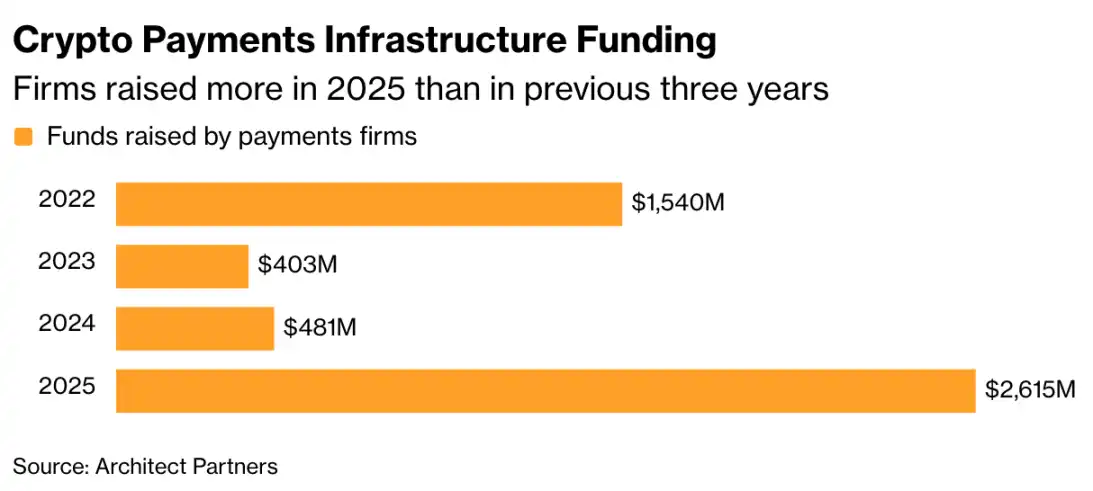
Crypto Payment Infrastructure Financing: Companies' Funding Exceeds Total of Previous Three Years in 2025
Meanwhile, overall private funding in the crypto industry increased from nearly $13 billion in 2024 to $20.4 billion in 2025, but it is still below the peak of $27.6 billion in 2022.
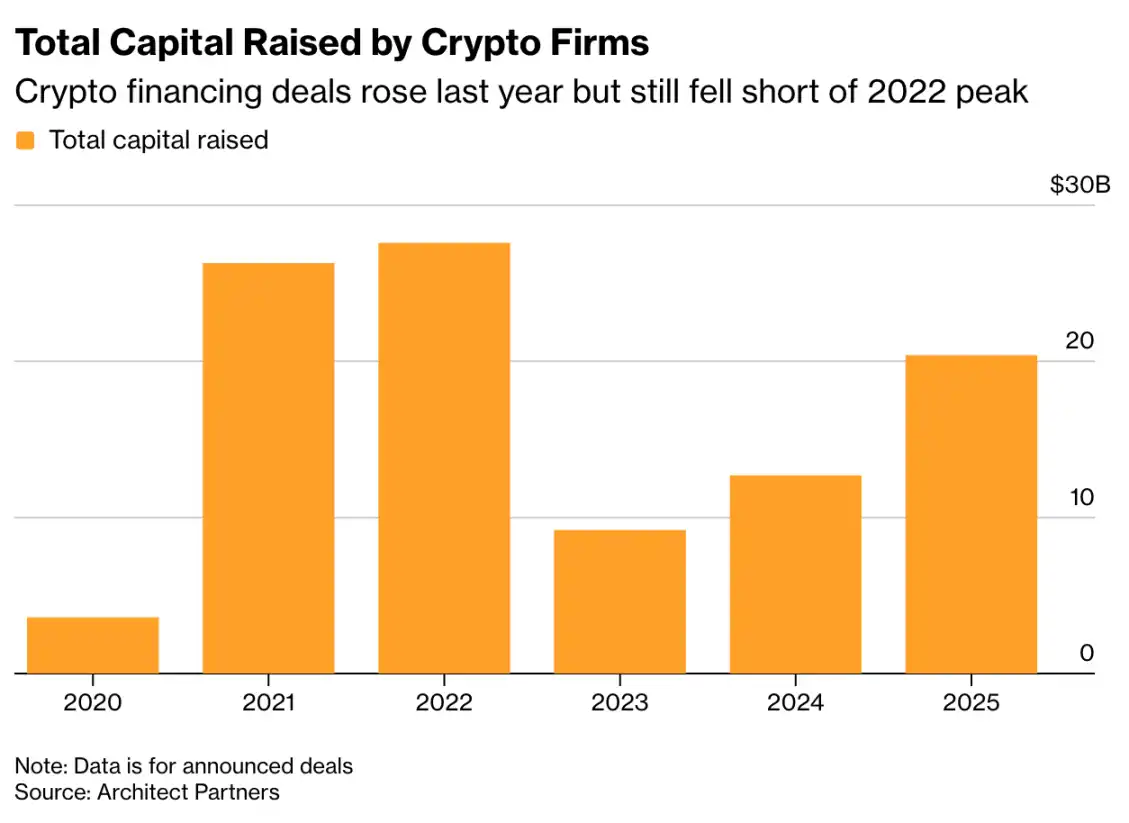
Cryptocurrency Company Funding Total: Cryptocurrency Funding Transaction Volume Increased Last Year but Has Yet to Reach 2022 Peak
The two areas currently most concentrated in private funding are "Investment & Trading Infrastructure" and "Brokers & Trading Platforms," both of which are financial application businesses. Payment infrastructure remains in third place. In sharp contrast, the chain game track, which was once at the core of the Web3 and NFT hype, went from $37.6 billion in funding in 2022 (about 14% of total funding) to not being listed as a separate category in 2025.
In fact, decentralized applications of all kinds in 2022 (Web3 functional layer) received a total of $5.2 billion in funding; whereas in the 2025 report, only consumer DApps were retained, with funding amounting to only $864 million.
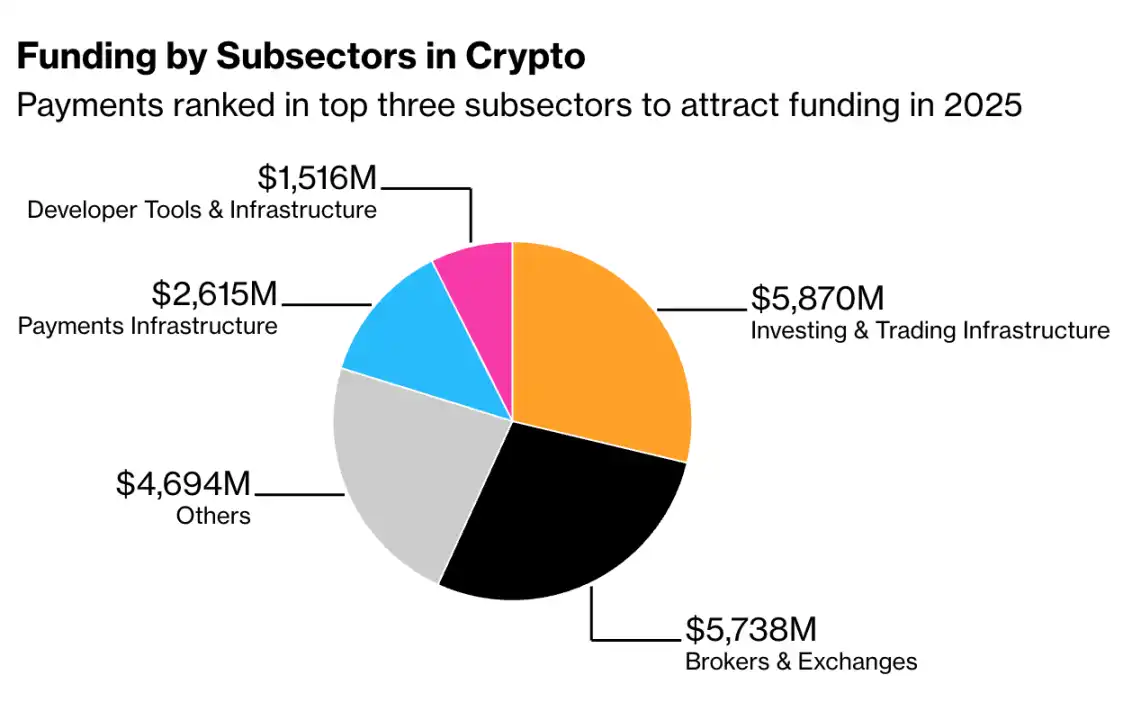
Cryptocurrency Financing Situation in Various Subfields: The Payment Field Ranks Among the Top Three Sub-Industries Attracting Funding in 2025
Stablecoins are building a more robust financial infrastructure for blockchain. These tokens are usually pegged 1:1 to the US dollar, with their value linked to the underlying asset. Driven by the pro-crypto policies of the Trump administration, market enthusiasm for stablecoins reached unprecedented heights last year.
According to Artemis Analytics data, stablecoin total transaction volume surged by 72% in 2025, reaching $33 trillion. The two largest stablecoins by market size are Tether's USDT and Circle's USDC.
Circle's stock price experienced its largest single-day drop on Tuesday as investors assess potential adjustments in US stablecoin regulations and the impact of increased industry competition. However, the core appeal of stablecoins remains clear: the efficient transfer of funds.
Cross-border payments are still slow, costly, and tie up significant funds. Despite years of fintech development, cross-border transfers still heavily rely on maintaining pre-funded accounts in different jurisdictions.
"Stablecoins have completely changed this landscape." Prajit Nanu, Co-founder and CEO of cross-border payments company Nium, said, "It allows value to move globally in real-time without incurring the same level of fund efficiency loss, which is why investors see it as the core infrastructure for the next generation of payments."
The industry still has strong "gatekeepers." Major payment networks such as Visa and Mastercard hold the access keys to the payment terminals. Eric F. Risley, Founder and Managing Partner of Architect Partners, wrote in a report that the distribution channel issue "is a major headache for every stablecoin and related payment company."
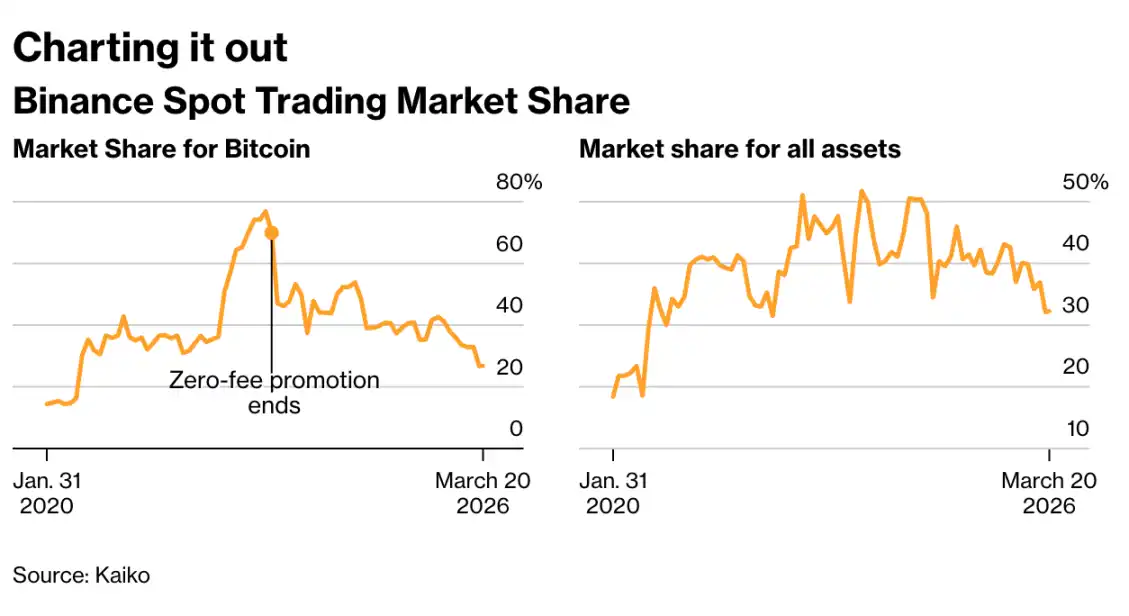
Binance Spot Trading Market Share Trend
As of February this year, Binance's share in Bitcoin spot trading has dropped to 27% (there is a certain difference in the data due to different statistical methods), and its share in spot trading for all coins has fallen from 52% to 32%. Its highest-profit derivative business share has also plummeted, down to 34%.
Franklin Dupton has partnered with Ondo Finance to launch an ETF tokenized product that can be traded 24/7 via a cryptocurrency wallet, bypassing the broker account and time-limited trading rules that fund investments have relied on for decades.
Industry Voices
"The fact that this event is taking place in Las Vegas right now is dripping with irony." Ben Johnson, Director of Customer Solutions at Morningstar, bluntly stated, "This industry has completely crossed the line between investment and gambling, with no turning back."
ETFs, originally designed to simplify investments, have now become the latest form of American financial gambling. Bloomberg Intelligence data shows that out of the 1,000 new funds issued last year, 36% were leverage products or crypto-related funds.
You may also like

BIS's latest research: The future of stablecoins and the global monetary landscape
Morning News | Michael Saylor releases Bitcoin Tracker information; Aave releases post-attack investigation on Kelp rsETH bridge; Gravity Bridge announces service suspension after being attacked
Three years later: Looking back at my judgment of ChatGPT in 2023

From Casino Tools to Global Pricing Machines: The NYSE Leader's Perspective on Hyperliquid

A Detailed Analysis of "Stock God Serenity" Investment Methodology

Sharplink CEO: The future of Ethereum is unfolding
Morning Report | Korea Investment & Securities and OKX plan to jointly acquire 40% of Coinone; Polymarket denies implementing KYC comprehensively; Grayscale delays U.S. stock IPO plans
Bit Digital CEO: Why I Bought More ETH

A Decade of Three Waves of Stock Tokenization from Bitget's Reality: An Unfinished Financial Exploration

"Hu Run Baifu" Dialogue with Sun Yuchen: A New Paradigm of Value Circulation in the Web3 Transformation Cycle

Is it hackers and regulation that ruined DeFi?

Chris Lee: From crypto OG to heavy investments in the three storage giants, predictions on AI bull market corrections, Web4, and opportunities for the younger generation

Ready for a Walk on the Wilder Side of Proof of Talk 2026? Join WEEX Labs in Paris

Gold vs Bitcoin in 2026: Which Market Is Giving Traders Better Opportunities?

Morning News | Coinbase partners with Standard Chartered Bank to expand multi-currency fiat channels; Sharplink and Forward will be included in the Russell Index; JPMorgan may issue stablecoins in the future

Hash Global Founder: Why I Also Chose to Liquidate All My ETH?

Tokenized US Stock Duel: Ondo vs. xStocks, Who is Defining On-Chain Nasdaq?

He Yideng ranked: Since you're here, you might as well
BIS's latest research: The future of stablecoins and the global monetary landscape
Morning News | Michael Saylor releases Bitcoin Tracker information; Aave releases post-attack investigation on Kelp rsETH bridge; Gravity Bridge announces service suspension after being attacked
Three years later: Looking back at my judgment of ChatGPT in 2023
From Casino Tools to Global Pricing Machines: The NYSE Leader's Perspective on Hyperliquid
A Detailed Analysis of "Stock God Serenity" Investment Methodology
Sharplink CEO: The future of Ethereum is unfolding

Contents
Popular coins
Latest Crypto News


