
Bloomberg: Market Prediction Giants at War, Kalshi and Polymarket Compete Fiercely


Original Title: 'Death Markets' and Attack Ads: Prediction Rivalry Turns Nasty
Original Author: Yash Roy, Bloomberg
Original Translation: Saoirse, Foresight News

This is an advertisement placed by the U.S. prediction market platform Kalshi on a Washington D.C. bus stop in March, with the slogan "We Don't Do Death Markets," emphasizing its own compliance with federal regulations, attacking competitor Polymarket for its overseas unregulated operations and sensitive contracts related to military conflicts. Photographer: Daniel Acker / Bloomberg
As the prediction market industry competition heats up, coupled with increased regulatory scrutiny from Washington, Kalshi and Polymarket are hurling heavyweight accusations at each other, engaging in fierce attacks.
The two platforms have clashed frequently in the past, but the recent conflict has escalated significantly—Kalshi has launched a targeted advertising campaign, and its employees have openly criticized Polymarket, with both sides' rhetoric becoming increasingly confrontational.
Benjamin Freeman, in charge of political and election markets at Kalshi, posted on social media on Monday, stating: "Polymarket's irresponsible, dangerous, and potentially illegal behavior is threatening the survival of legitimate U.S. prediction markets."
This accusation quickly sparked fierce exchanges between the two companies.
Polymarket responded in a statement: "We welcome competition, but believe that discussions should be based on facts. Misleading the public will only harm the entire industry and its participants."
Kalshi spokesperson Elisabeth Diana directly retorted: "Coming from a company with the vast majority of its trading volume offshore and unregulated, whose platform rules even allow for the existence of 'death markets,' this is simply laughable."
(Note: Death Markets refer to a category of trading contracts in the prediction market industry where the outcome is directly or indirectly tied to events such as loss of life, military conflicts, assassinations, etc., also known as "assassination markets.")
At the height of this internal conflict, it is a critical moment for Polymarket and Kalshi as they compete for the leading position in the high-growth prediction market industry. This industry has provided Americans with a new way to bet on various events such as sports matches and election results. According to user-sourced data on Dune Analytics, both startups have recently set consecutive weekly trading volume records, with a combined total nominal trading volume approaching $6 billion.
Prediction Market Trading Reaches Billions in Scale
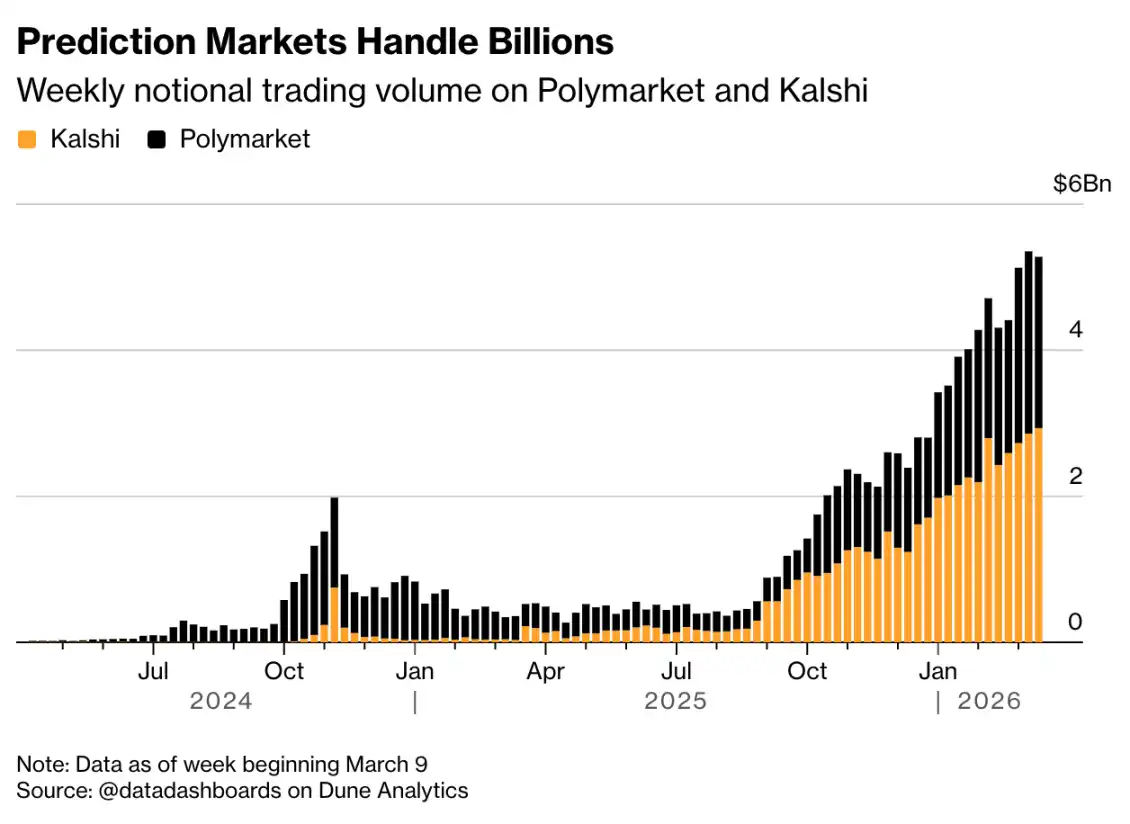
Weekly nominal trading volume for Polymarket and Kalshi. Note: Data as of the week ending March 9, source: @datadashboards on Dune Analytics
The core of the dispute lies in the fundamental differences in the establishment model and operating rules of the trading platforms. Kalshi, based in the United States, is regulated by the Commodity Futures Trading Commission (CFTC); whereas Polymarket's main trading platform is located overseas.
Capitalizing on its overseas operational advantage, Polymarket has launched contracts related to military conflicts, including those involving Iran, a type of product that Kalshi bluntly states is neither ethical nor legal.
A straightforward Kalshi ad reads: "We don't run death markets."
Earlier this week, Kalshi's marketing campaign, in the form of a "Platform Rules List," started appearing on buses and subways in Washington, D.C.
One of the rules states: "Rule 1: We strictly prohibit insider trading because Kalshi is a federally regulated U.S. trading platform." To industry observers, the implication of this statement is clear: Polymarket's main platform is not under the jurisdiction of U.S. regulatory bodies.
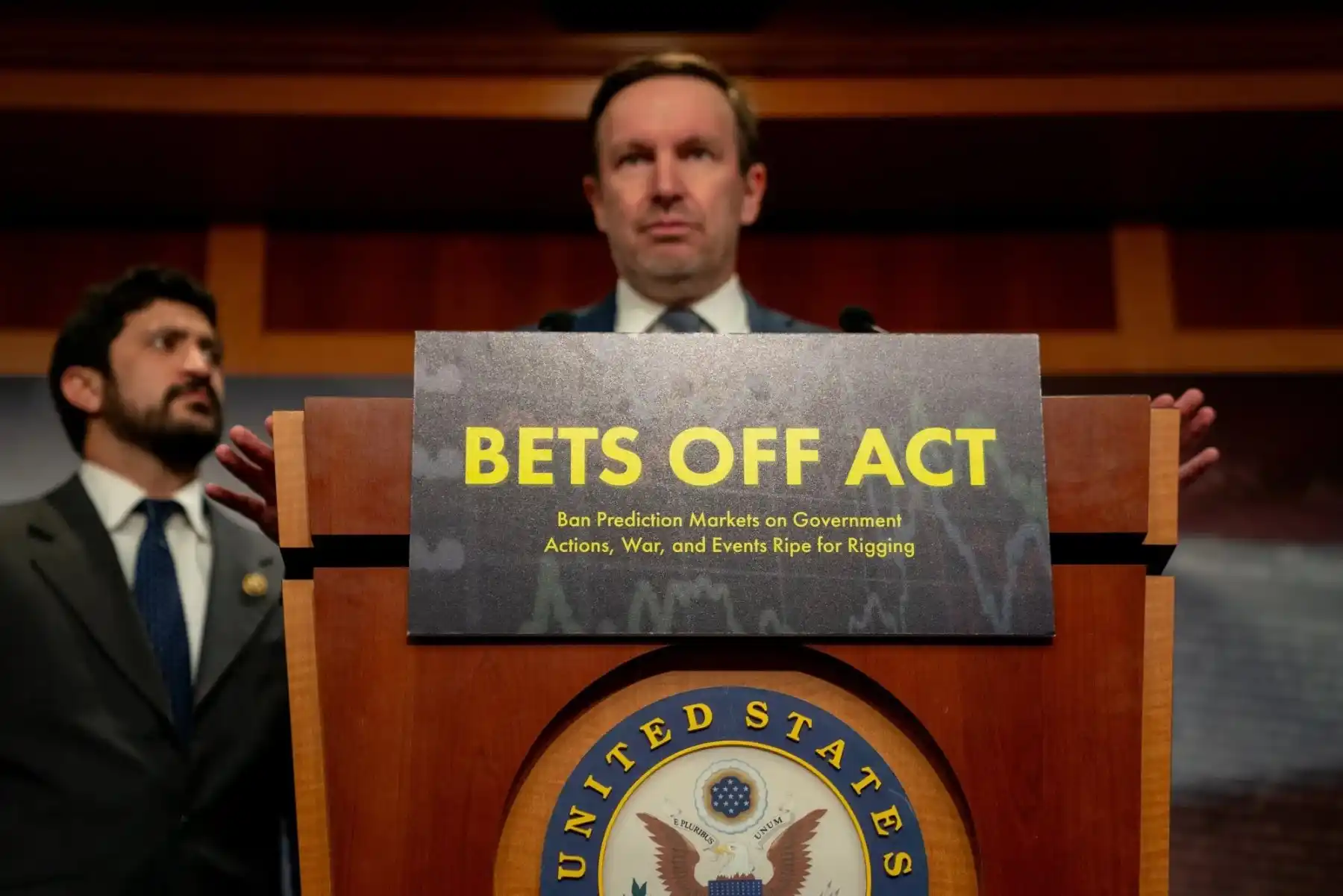
"BETS OFF Act" signage, with Representative Greg Casar and Senator Chris Murphy speaking at a press conference on the "Ban on Engagement in Sensing and Federal Function Act" (BETS OFF Act). Photographer: Stefani Reynolds / Bloomberg
Previously, there were accusations that individuals were using insider information to inappropriately bet on U.S. military actions in Iran and Venezuela, prompting Congress to shift its focus to insider trading issues in the prediction market. In response, Kalshi has taken a stronger stance, imposing fines and trading suspensions on users identified for misconduct; Polymarket, on the other hand, has been relatively laissez-faire but has recently announced its own rules on insider trading as regulatory scrutiny intensifies.
Kalshi spokesperson Diana said: 「We want to clarify these significant differences. Currently, many people in the market confuse Kalshi with Polymarket and also misunderstand the different regulatory paths our two companies are on.」
In addition to its main offshore platform, Polymarket also has a US-regulated platform that is currently in the testing phase. The company stated that both of its platforms enforce 「equally rigorous market integrity standards, including prohibiting insider trading and market manipulation, actively monitoring trades, and continuously engaging with regulatory and law enforcement agencies for cooperation.」
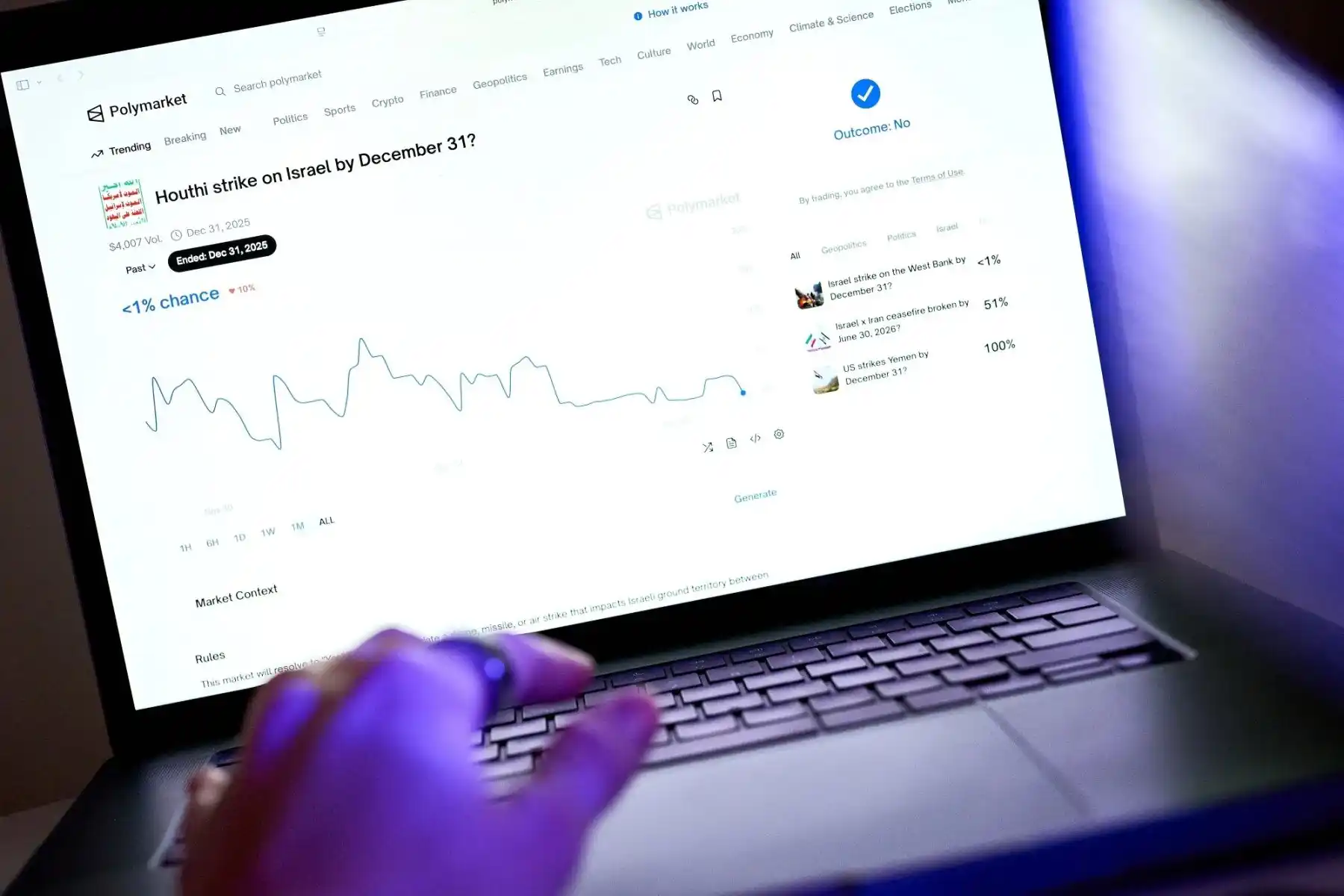
Polymarket hosts trades on whether the Houthi militia will attack Israeli territory. Photographer: Gabby Jones / Bloomberg
Just a few months ago, Kalshi co-founder Luana Lopes Lara had attempted to ease tensions between the two rivals. In a social media post in October of last year, she expressed hope that the industry could move away from 「destructive infighting」 and work together for growth.
It seems that this vision has now largely dissipated.
Especially after Kalshi advisor and former CFTC Commissioner Brian Quintenz joined the fray, the conflict has become harder to reconcile. In response to reports of prosecutors investigating insider trading, Brian Quintenz hinted on social media earlier this week that the focus of such investigations should be on Polymarket. When contacted by Bloomberg News, he declined to comment further.
You may also like

Morning News | Michael Saylor releases Bitcoin Tracker information; Aave releases post-attack investigation on Kelp rsETH bridge; Gravity Bridge announces service suspension after being attacked
Three years later: Looking back at my judgment of ChatGPT in 2023

From Casino Tools to Global Pricing Machines: The NYSE Leader's Perspective on Hyperliquid

A Detailed Analysis of "Stock God Serenity" Investment Methodology

Sharplink CEO: The future of Ethereum is unfolding
Morning Report | Korea Investment & Securities and OKX plan to jointly acquire 40% of Coinone; Polymarket denies implementing KYC comprehensively; Grayscale delays U.S. stock IPO plans
Bit Digital CEO: Why I Bought More ETH

A Decade of Three Waves of Stock Tokenization from Bitget's Reality: An Unfinished Financial Exploration

"Hu Run Baifu" Dialogue with Sun Yuchen: A New Paradigm of Value Circulation in the Web3 Transformation Cycle

Is it hackers and regulation that ruined DeFi?

Chris Lee: From crypto OG to heavy investments in the three storage giants, predictions on AI bull market corrections, Web4, and opportunities for the younger generation

Ready for a Walk on the Wilder Side of Proof of Talk 2026? Join WEEX Labs in Paris

Gold vs Bitcoin in 2026: Which Market Is Giving Traders Better Opportunities?

Morning News | Coinbase partners with Standard Chartered Bank to expand multi-currency fiat channels; Sharplink and Forward will be included in the Russell Index; JPMorgan may issue stablecoins in the future

Hash Global Founder: Why I Also Chose to Liquidate All My ETH?

Tokenized US Stock Duel: Ondo vs. xStocks, Who is Defining On-Chain Nasdaq?

He Yideng ranked: Since you're here, you might as well
The era of regulatory arbitrage has come to an end, and the value of cryptocurrency exchange licenses is being fiercely contested
Morning News | Michael Saylor releases Bitcoin Tracker information; Aave releases post-attack investigation on Kelp rsETH bridge; Gravity Bridge announces service suspension after being attacked
Three years later: Looking back at my judgment of ChatGPT in 2023
From Casino Tools to Global Pricing Machines: The NYSE Leader's Perspective on Hyperliquid
A Detailed Analysis of "Stock God Serenity" Investment Methodology
Sharplink CEO: The future of Ethereum is unfolding
Morning Report | Korea Investment & Securities and OKX plan to jointly acquire 40% of Coinone; Polymarket denies implementing KYC comprehensively; Grayscale delays U.S. stock IPO plans


