
Binance's Most Profitable Yield Farming Stablecoin? Understanding LDUSDT's "Fee and Interest Double Earning" in One Article


Just yesterday, Binance announced the upcoming launch of a new reward-bearing margin asset called LDUSDT. This is another "stablecoin" financial product that can be used as margin for contract trading, following the launch of BFUSD in November 2024. What is LDUSDT, and how does it differ from BFUSD?
A "Stablecoin" That Is Not a Stablecoin
LDUSDT is a "yield-bearing margin asset" designed by Binance specifically for futures trading, with the official notice emphasizing that it is not a stablecoin. Users can convert their held USDT simple yield flexible product assets into LDUSDT.
LDUSDT serves two purposes: it can be used as trading margin while also earning yield. Binance allows users to use LDUSDT as margin for perpetual contract (inverse perpetual contract) trading, and users holding LDUSDT can continue to earn real-time annualized interest from Binance's "Principal Protected Coin" current product.
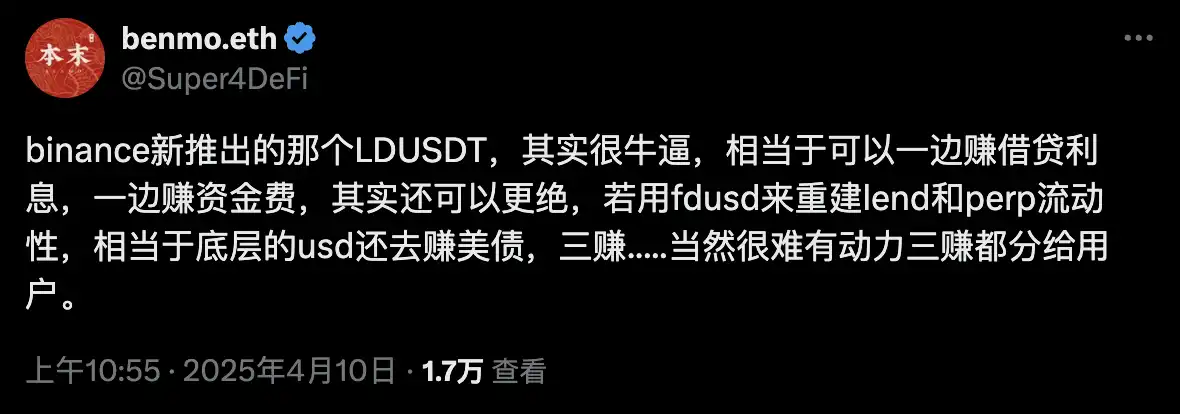
In simple terms, similar to the previously launched BFUSD, LDUSDT allows users' assets to simultaneously have "low-risk yield" and "liquidity." This is beneficial for Binance as well, as it can earn more lending interest while also earning more contract funding rates. The founder of the OG Crypto Community proposed that "if Binance chooses to use FDUSD to rebuild lending and perpetual contract liquidity, the underlying USD can also earn U.S. Treasury bonds." According to the reserve report presented by First Digital Labs on February 28th, 85% of the underlying USD composition of FDUSD consists of U.S. Treasury bonds. This is essentially a win-win situation, with LDUSDT being a product through which Binance shares the above-mentioned benefits with users.
How Is It Different from BFUSD?
After Binance launched BFUSD on November 27, 2024, similar products appeared, such as Dex Backpack and HUOBI Exchange, but their influence was not as significant as Binance's BFUSD. However, after the launch of BFUSD, although the model was innovative and participants generally believed that the model could improve liquidity, some issues with the product also emerged.
There is high yield volatility. The yield of BFUSD includes both the base interest rate and trading bonuses, with the holding limit linked to VIP levels. This model is highly dependent on market conditions and users' own trading activities. While it could reach a peak APY of up to 38%, if the market is in a one-sided trend or the trading volume is insufficient, the actual yield may be lower than expected, even approaching the minimum value of the base interest rate. During the high market liquidity at the end of last year, the APY could be maintained at around 20-30%, but starting from February-March this year, the APY has been close to 0% on many occasions.
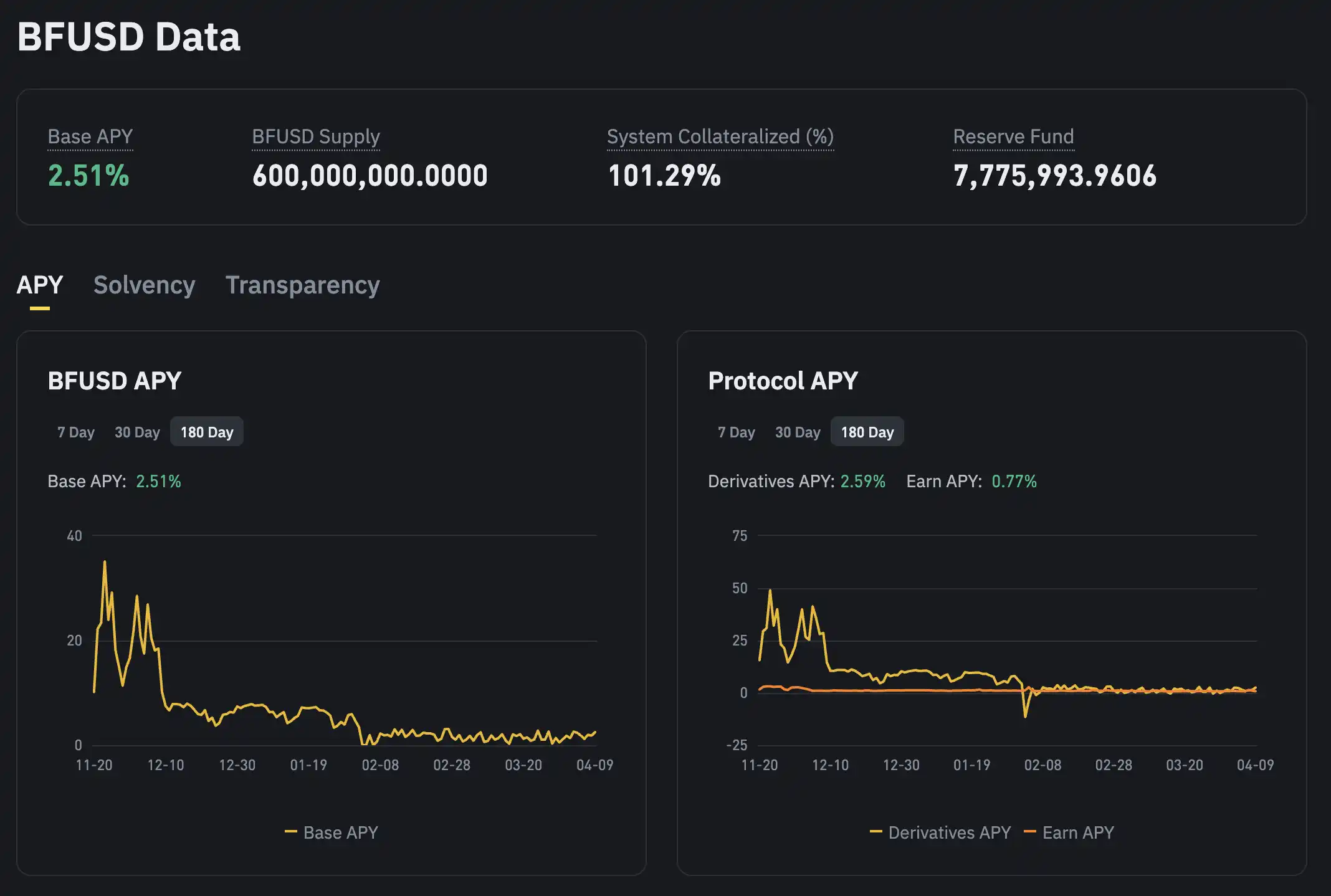
The interest rates for retail and professional traders are different. The additional reward of BFUSD is linked to user's futures trading volume, allowing high-frequency traders or whales to significantly increase their earnings. In contrast, regular users with low trading volume may only receive the base interest rate, making the cost-effectiveness low. This design of BFUSD leans more towards professional traders rather than ordinary retail traders.
On the other hand, LDUSDT, although similar in its usage to BFUSD, has a different income structure. BFUSD is based on hedging strategies and staking, while LDUSDT's income comes from Binance sharing the annualized returns of its "Simple Earn" where users can earn risk-free returns, including a portion of platform fees, lending income, or some low-risk investment returns.
Due to these reasons, BFUSD is currently not popular in the market. Unlike BFUSD, which can experience significant fluctuations due to funding rate volatility, LDUSDT's advantage lies in its relative stability. However, the trade-off is that its yield may not be as high. While these yields may seem insignificant during a bull market, they present a good option for those seeking stable returns and liquidity during times of relatively low liquidity. Additionally, as it does not rely on the user's trading strategy, its operation is comparatively simple, thereby enabling more retail investors to participate.
Successive Launch of Yield Stablecoins, What Is Binance's Intention?
Overall, BFUSD is more like an investment tool created by Binance to provide additional value to users through proactive actions, a "Buff" of additional gains for traders who frequently trade during a "bull market." On the other hand, LDUSDT acts as a gateway, bridging the gap between Simple Earn and futures trading, a product that incentivizes conservative users to trade during a "bear market."
KOL "Loki_Zeng" expressed his feelings about this, saying, "Binance is so innovative. Thinking about the interest and circulation separation of stablecoins will inevitably lead to a final scenario, but I didn't expect Binance itself to revolutionize it." Whether BFUSD or LDUSDT, what Binance aims to do is to activate a large amount of idle stablecoins on the exchange, wrap them in a leveraged shell, and keep them within the Binance ecosystem to continue providing vitality to real business.
The water in this liquidity sponge is being squeezed by a larger hand. Can it help us survive the dry spell before the "water release"? Currently, Binance has not released more detailed information about LDUSDT, and BlockBeats will continue to monitor this matter.
You may also like

Interview with macro master Raoul Pal: The AI competition is giving rise to an "economic singularity," don't easily give up your chips in the next four years

Wang Chuan: How can one not feel anxious after the neighbor Old Wang made thirty times his investment in storage stocks? (Six) - The Trap of Homogeneous Products

"Trapped in the cryptocurrency world: Don't let the anxiety of missing out force you onto the most dangerous last train."

BIS's latest research: The future of stablecoins and the global monetary landscape
Morning News | Michael Saylor releases Bitcoin Tracker information; Aave releases post-attack investigation on Kelp rsETH bridge; Gravity Bridge announces service suspension after being attacked
Three years later: Looking back at my judgment of ChatGPT in 2023
From Casino Tools to Global Pricing Machines: The NYSE Leader's Perspective on Hyperliquid

A Detailed Analysis of "Stock God Serenity" Investment Methodology

Sharplink CEO: The future of Ethereum is unfolding
Morning Report | Korea Investment & Securities and OKX plan to jointly acquire 40% of Coinone; Polymarket denies implementing KYC comprehensively; Grayscale delays U.S. stock IPO plans
Bit Digital CEO: Why I Bought More ETH

A Decade of Three Waves of Stock Tokenization from Bitget's Reality: An Unfinished Financial Exploration
"Hu Run Baifu" Dialogue with Sun Yuchen: A New Paradigm of Value Circulation in the Web3 Transformation Cycle

Is it hackers and regulation that ruined DeFi?

Chris Lee: From crypto OG to heavy investments in the three storage giants, predictions on AI bull market corrections, Web4, and opportunities for the younger generation

Ready for a Walk on the Wilder Side of Proof of Talk 2026? Join WEEX Labs in Paris

Gold vs Bitcoin in 2026: Which Market Is Giving Traders Better Opportunities?

Morning News | Coinbase partners with Standard Chartered Bank to expand multi-currency fiat channels; Sharplink and Forward will be included in the Russell Index; JPMorgan may issue stablecoins in the future
Interview with macro master Raoul Pal: The AI competition is giving rise to an "economic singularity," don't easily give up your chips in the next four years
Wang Chuan: How can one not feel anxious after the neighbor Old Wang made thirty times his investment in storage stocks? (Six) - The Trap of Homogeneous Products
"Trapped in the cryptocurrency world: Don't let the anxiety of missing out force you onto the most dangerous last train."
BIS's latest research: The future of stablecoins and the global monetary landscape
Morning News | Michael Saylor releases Bitcoin Tracker information; Aave releases post-attack investigation on Kelp rsETH bridge; Gravity Bridge announces service suspension after being attacked
Three years later: Looking back at my judgment of ChatGPT in 2023


